
For the past two years, the tech industry has been buzzing with the promise of a big change. Artificial intelligence was expected to reduce software development cycles from weeks to days, or even hours. AI assistants promised to generate code faster than any human could. We heard bold claims about ten times productivity, instant prototyping, and a revolution in engineers’ workflows.
Yet the latest studies show something few are willing to say. In many cases, AI does not speed up developers; it actually slows them down. The people who are impacted the most are those who excel at their jobs.
This conclusion goes against the tech sector’s marketing message. However, we cannot ignore it.
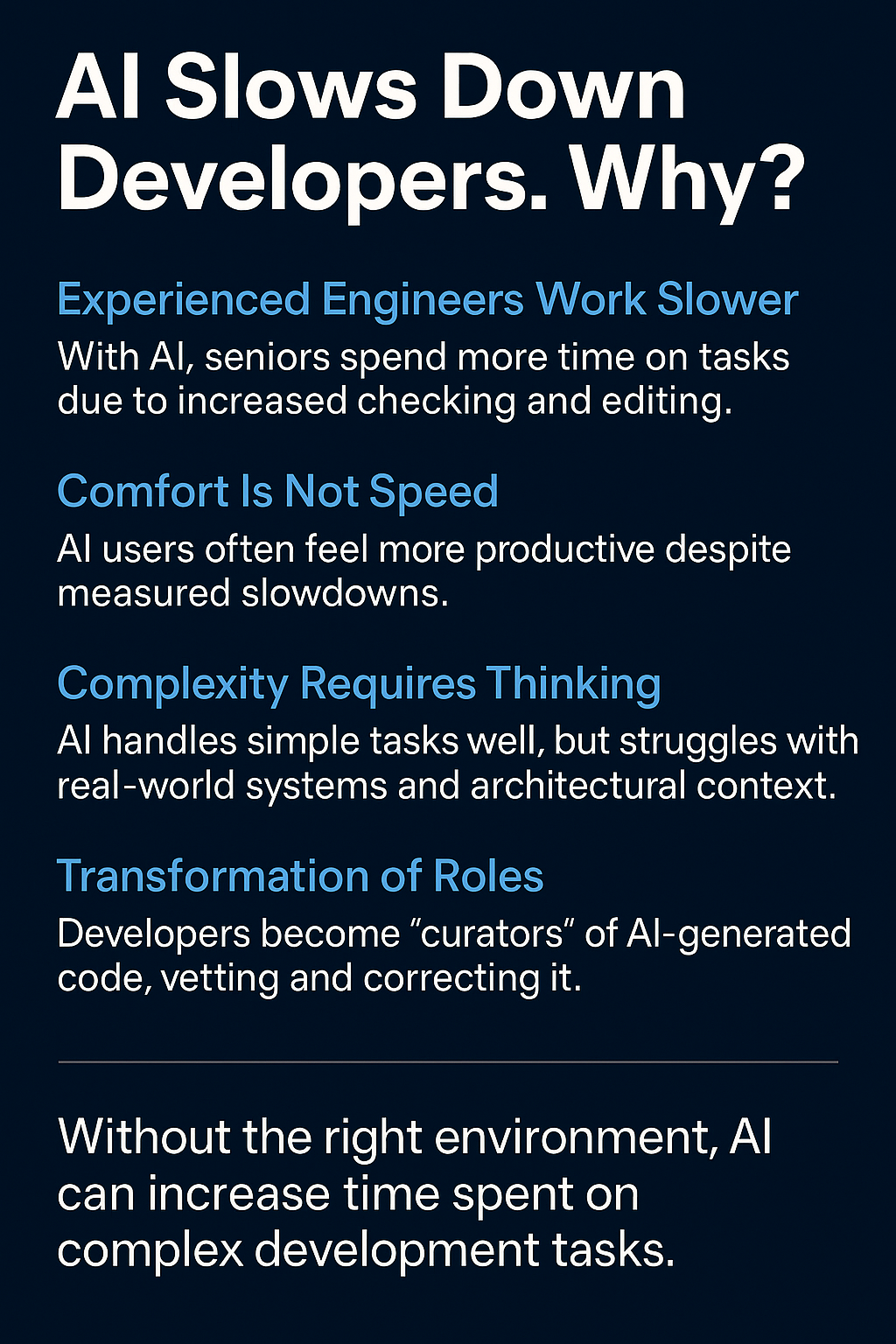
Experienced engineers work more slowly with AI. Yes, more slowly.
In the METR study, seasoned engineers took longer to complete the same tasks when using AI assistants. These engineers have years of experience with complex systems, and they deeply understand the code, architecture, and context. AI produced code that seemed correct at first but required more checking, editing, and adjustments.
For a senior engineer, writing code isn’t the issue. The real problem is code that doesn’t fit the system. It can bring unpredictability or simply be superficially correct.
AI speeds up typing but slows down critical thinking. Thinking is exactly what we pay senior engineers to do.
Convenience is not the same as speed.
The research revealed something that rarely gets talked about. AI users felt they were working faster, even though objective measurements showed otherwise. This phenomenon can be called the illusion of productivity. Comfortable suggestions can make the work seem smoother. Psychologically, it can feel like progress is happening more quickly.
But feelings are not a true measure of productivity. Many companies confuse comfort with efficiency, and in coding, AI mainly provides comfort.
AI handles simple tasks very well. But the real world is different.
AI can write small functions beautifully. It handles repetitive, routine pieces of code effectively. It also helps junior developers learn new languages. That’s true.
But real systems involve complexity, technical debt, architectural context, unclear requirements, and the need to understand the impact of every change.
AI does not grasp consequences.
AI doesn’t understand context like a human does.
AI isn’t responsible for the systems it disrupts.
As a result, the more complicated the task, the more AI adds extra work instead of saving time.
Instead of speeding up senior engineers, AI turns them into error-checkers.
Another issue is emerging. Developers stop being the authors of code and become curators of code generated by machines. Their new role involves reviewing, correcting, and securing the generated code fragments. These activities are important, but they require time, focus, and accountability.
This isn’t acceleration; it’s a shift in the role. Not every leader is comfortable with what that means.
It’s not AI that slows things down; it’s the organization’s unpreparedness.
Many companies implement AI tools without changing their processes. They lack new quality standards and don’t have a dedicated validation layer for AI-generated code. They also don’t update their testing methods.
The result? Chaos hidden behind flashy technology.
AI improves the quality of the environment in which it works.
If the environment is mature, AI is beneficial.
If it’s immature, AI makes things worse.
Does AI make sense in software development? Of course it does.
But not as a magic solution. Not as a promise of ten times productivity. Not as a replacement for senior engineers.
AI is a tool, and its value comes from having the right conditions for it to be effective. We need processes in place. A culture that values quality is essential. We need a realistic way to measure performance not just marketing hype.
The industry must stop believing its own stories.
Every technological revolution goes through a honeymoon phase. For AI, this phase has lasted unusually long. Now we face reality. This confrontation is healthy because it compels us to ask an important question.
Not whether AI can generate code.
Not if it can make junior developers faster.
The real question is:
Can AI speed up the work of experienced engineers on the most crucial projects?
Today, the answer is: not always.
And sometimes, it’s the opposite.
This isn’t the end of the story, it’s just the beginning.
If we refine our processes, understand the limits of these models, and teach teams to use AI effectively, productivity will increase. The potential is vast. But unlocking this potential requires careful adaptation and realistic expectations.
The biggest mistake would be to believe in a miraculous technology that can achieve efficiency on its own.
AI does not create efficiency.
AI does not understand architecture.
AI does not take responsibility.
All of those responsibilities remain ours.
Related articles:
– Algorithms born of our prejudices
– Will algorithms commit war crimes?
– Machine, when will you learn to make love to me?
– Artificial Intelligence is a new electricity
References
- METR (2025). Measuring the Impact of Early-2025 AI on Experienced Open-Source Developer Productivity.METR Research Report, July 2025. Available at: https://metr.org/blog/2025-07-10-early-2025-ai-experienced-os-dev-study/
- Cui, Z., Demirer, M., Jaffe, S., Musolff, L., Peng, S. & Salz, T. (2025). The Effects of Generative AI on High-Skilled Work: Evidence from Three Field Experiments with Software Developers. SSRN Working Paper. Available at: https://ssrn.com/abstract=4945566
- Lyu, Y., Yang, Z., Shi, J., Chang, J., Liu, Y. & Lo, D. (2025). “My Productivity Is Boosted, but …” Demystifying Users’ Perception on AI Coding Assistants. arXiv preprint arXiv:2508.12285. Available at: https://arxiv.org/abs/2508.12285