Everyone says that AI is replacing consulting. I think we are missing the main issue.
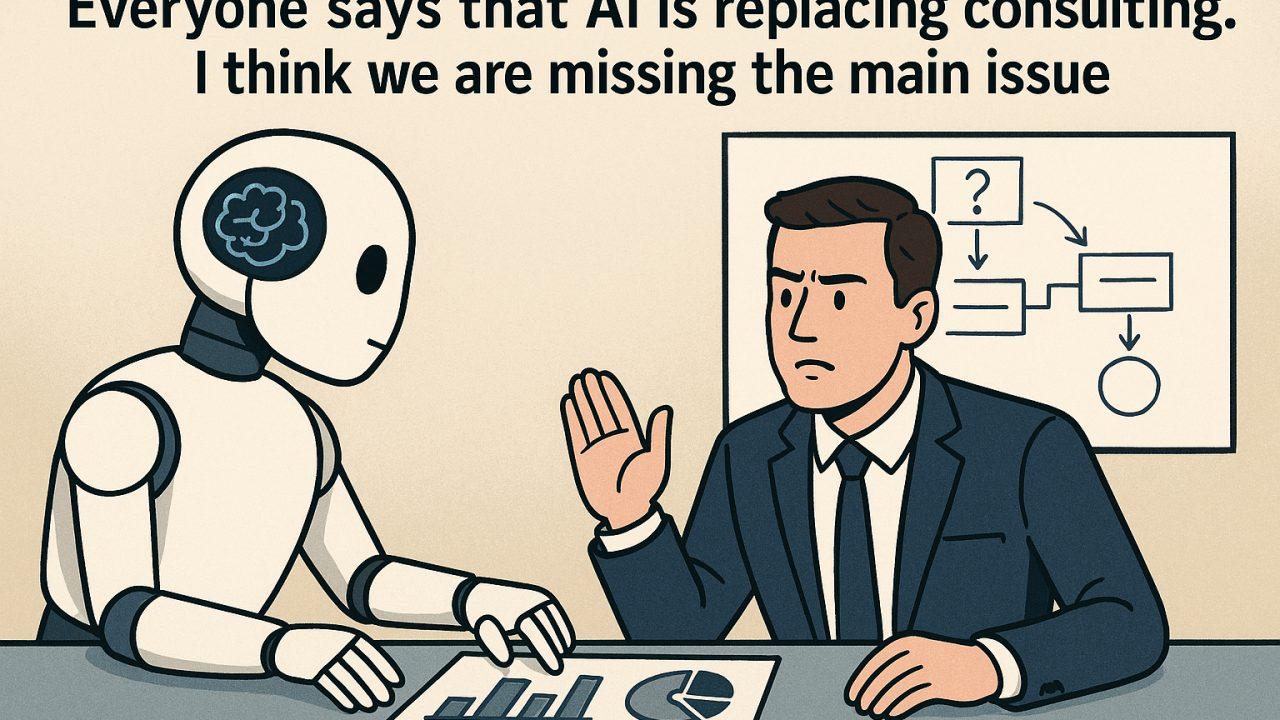
In recent months, the debate about consulting has grown. AI is changing everything. Consultants could lose their jobs. Strategy work might be automated. Slides could be made in seconds without any human help.
I understand the excitement. AI is truly impressive. It speeds up analysis, cuts down on content creation costs, and improves output quality. However, my experience, which includes many years in consulting and being hired twice by McKinsey, leads me to believe this view misinterprets the essence of consulting.
This isn’t a defense of McKinsey or any consulting firm. It reflects the nature of the work itself.
Tools, not results
From an outside perspective, consulting often appears to focus on documents, frameworks, analyses, and presentations. This is where AI is advancing the fastest. But these products were never the true value of the work. They are tools, not the results.
Real consulting work has always started earlier and continued later than the slide deck. It begins with finding the right problem, not just answering the one given. It involves organizing ambiguity, incomplete information, and conflicting views from stakeholders. It ends with decisions people are willing to take responsibility for, not just ideas that look good on paper.
This is where AI struggles, at least for now. Not because it lacks intelligence, but because it lacks context, judgment, and accountability.
AI can generate content effectively. It can create a market analysis, a strategy outline, or a financial scenario faster than any team I have worked with. However, it cannot determine what matters most in the organization at this time, given real constraints. It cannot read the room, sense political tensions, or understand which recommendation will hold up in reality.
Communication matters as much as content
One key lesson I learned at McKinsey is that communication matters as much as content. A brilliant analysis that is poorly communicated is almost indistinguishable from a bad one. Conversely, a simple idea that is clearly explained and delivered confidently often has a greater impact than the most complex model.
Consulting has always been about shaping conversations as much as giving answers. It’s about knowing when to simplify, when to push, and when to step back. These are human skills developed through apprenticeship and experience, not generated on demand.
What is fading, and what is not
The consulting industry is changing, no doubt. There will be less mechanical work and fewer slides created just for the sake of it. There will be less tolerance for analysis without clear results. In this sense, AI is a positive force.
But the consulting profession is not disappearing. What is fading is the idea that consulting was mainly about producing content. At its core, it has always centered on judgment, communication, and taking responsibility in situations where decisions are costly and uncertainty is high.
AI will set a new standard. It will remove inefficiencies. It will change the skill set. But it will not take over the human task of helping leaders think clearly and make decisions under uncertainty. If anything, it will make that task more visible.
A brilliant analysis poorly communicated is useless. A simple insight, clearly framed, can change a boardroom. AI is great at producing answers. It still struggles with influence, timing and context.
That gap still matters.
